This page shows one ClassPlus output as it came out of the demo account: a Basic Physics lecture transcript on Newton’s laws, turned into illustrated slides, a quiz, and flashcards.
Example from the demo account. The transcript is a simulated lecture written with AI, not a recording of a real class. The output below was generated by ClassPlus on 29 September 2026 and has not been edited by a teacher. The material is in Indonesian; text on this page is translated.
Input
One lecture transcript (simulated)
Slides
10 illustrated slides
Quiz
50 multiple-choice questions
Flashcards
50 cards
Generated
29 September 2026
01
Transcript
Opening of the uploaded transcript (translated).
Welcome back to the online lecture series for Basic Physics 1. Today we start a new topic: dynamics. It is split into several parts over two sessions. In this first part we cover Newton’s laws of motion. Let’s begin with an illustration. There is a block resting on a flat floor.
02
Slides
3 of the 10 generated slides. Each slide has an illustration and an explanation (slide images are in Indonesian).
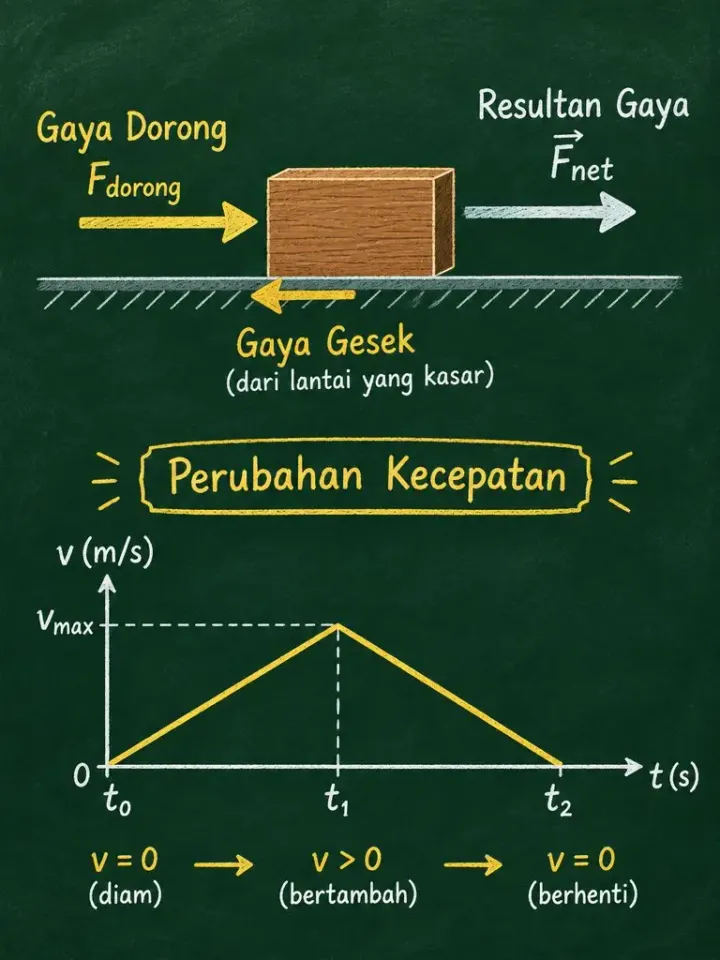
Dynamics: how force relates to changes in motion
Dynamics is the branch of physics that explains why an object’s motion changes. If a block at rest starts moving, or a moving block stops, a force (F) acts on it, such as a push or friction.
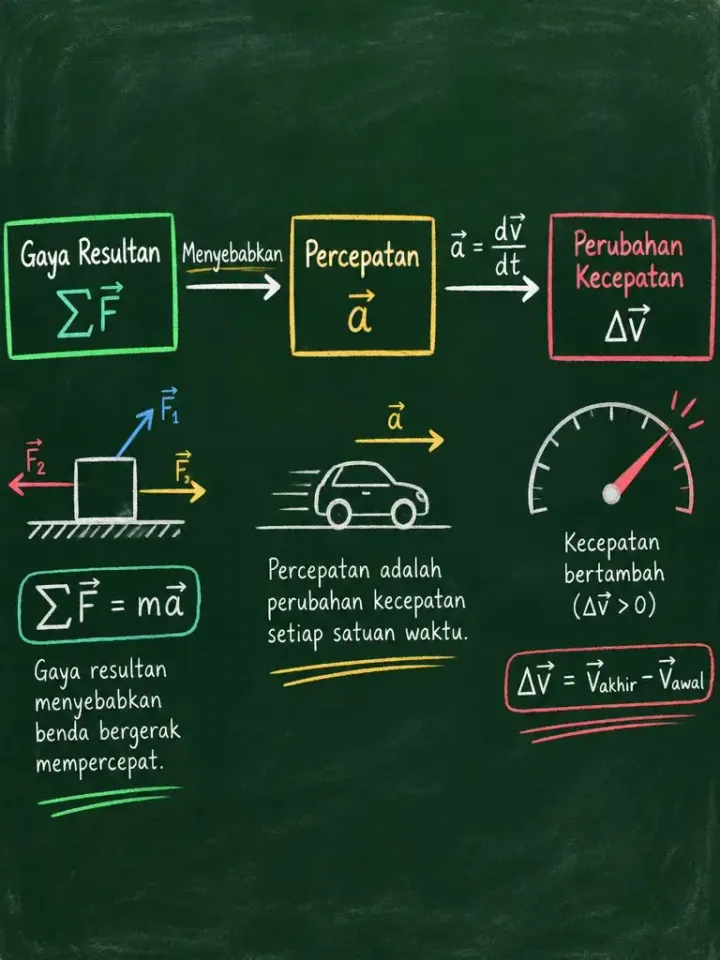
How force relates to acceleration
In kinematics, acceleration is the derivative of velocity with respect to time, a = dv/dt. In dynamics, force is what causes that acceleration.
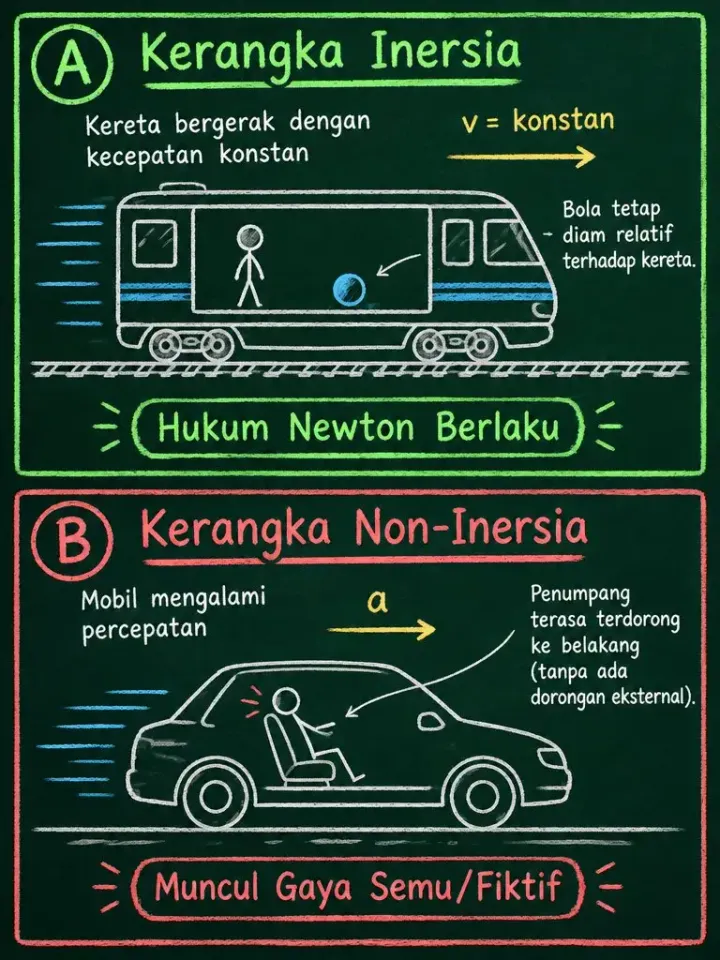
When the inertial frame applies
Newton’s first law holds only in an inertial (non-accelerating) frame of reference. Outside it, the law seems to fail because fictitious forces appear that do not come from a real physical interaction.
03
Quiz
2 of 50 quiz questions. Each question is tagged with a Bloom’s taxonomy level.
Understanding
What is the main condition for Newton’s first law to hold without adding fictitious forces?
AThe object must have a very large mass.
BThe observation is made in an inertial frame of reference (at rest or moving at constant velocity).(Correct answer)
CThe surface must be perfectly frictionless.
DGravity must be ignored completely.
Newton’s first law is valid only in an inertial frame. In an accelerating frame, objects appear to change velocity without a real force, which requires fictitious forces.
Applying
An object of mass m receives a force of 2F instead of F (same mass). How does its acceleration change according to Newton’s second law?
AIt halves (a/2).
BIt stays the same (a).
CIt doubles (2a).(Correct answer)
DIt quadruples (4a).
From a = F/m, acceleration is proportional to the net force. Doubling the force with the same mass gives 2F/m = 2a.
04
Flashcards
2 of 50 flashcards. Flashcards come in several explanation styles.
Logical
Front
How are acceleration (a), net force (F net), and mass (m) related, before the formal equation?
Back
With constant mass, a larger force gives a larger acceleration (proportional). With constant force, a larger mass gives a smaller acceleration (inversely proportional).
Kinesthetic
Front
In dv/dt, what does the derivative mean physically when you feel a car accelerate?
Back
d/dt is the rate of change of velocity over time. The push you feel into the seat is acceleration made physical.
05
Teacher review
Before sharing, teachers and lecturers can review and edit quizzes. AI suggestions for essay grades are reviewed too; the final grade is always theirs. The example on this page has not been through that review.